
UNE-EN ISO 21904 Standard: Requirements for Welding Fume Extraction
Safety and Fume Capture at Source
Welding processes generate fumes containing particles that may be harmful to health. Exposure to these contaminants is one of the main occupational hazards associated with welding operations.
Capturing fumes at source through local exhaust ventilation systems helps reduce their dispersion into the workplace environment and limits workers’ exposure.
The UNE-EN ISO 21904 series of standards establishes the technical requirements and testing methods applicable to equipment designed for the capture and filtration of welding fumes.
What Does the UNE-EN ISO 21904 Standard Establish?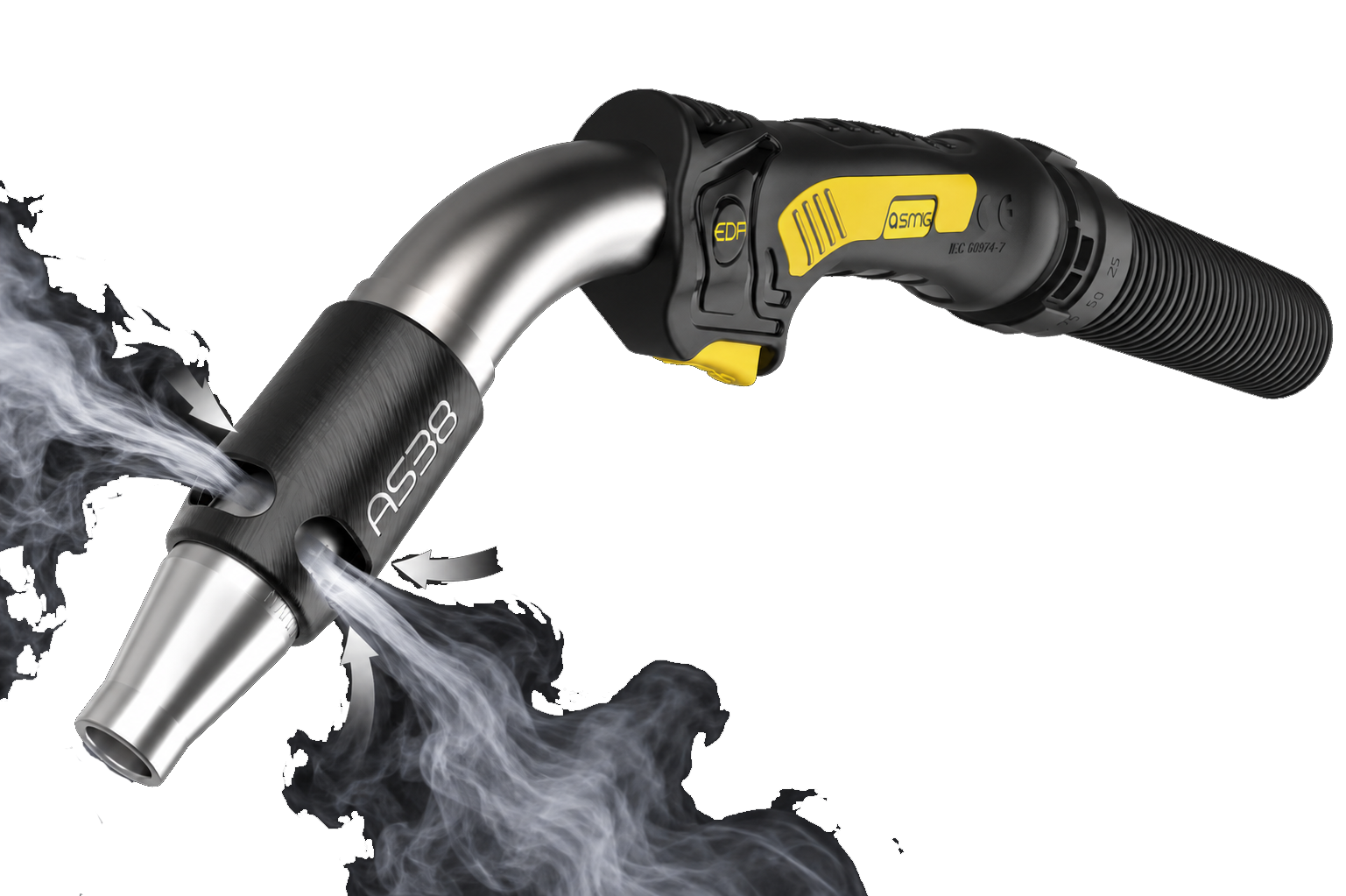
This series of standards covers various aspects related to the operation, safety, and performance evaluation of fume extraction systems.
UNE-EN ISO 21904-1: General Requirements
This standard establishes the general requirements for welding fume capture and filtration equipment, including operating conditions, malfunction warning systems, and the information that manufacturers must provide.
For welding torches with integrated fume extraction, it specifies two minimum induced air velocities, depending on the rated welding current:
- Torches rated up to 200 A: minimum induced air velocity of 0.25 m/s.
- Torches rated above 200 A: minimum induced air velocity of 0.35 m/s.
These velocities must be achieved with a maximum negative pressure of 18 kPa at the torch connector.
UNE-EN ISO 21904-4: Determination of the Minimum Airflow Rate
This standard defines the procedure for determining the volumetric airflow rate required to achieve the specified induced air velocity.
For welding torches with integrated fume extraction, the calculation is primarily based on two parameters:
- Required induced air velocity: determined according to the rated welding current of the torch.
- Extraction distance: the distance between the fume generation point, conventionally located 20 mm from the end of the contact tip, and the furthest extraction inlet.
The relationship between these parameters is used to establish the airflow rate required at the extraction nozzle.
Subsequently, the testing procedure specified in the standard determines the required negative pressure and the actual airflow rate at the torch connector.
UNE-EN ISO 21904-3: Determination of Capture Efficiency
This standard establishes a laboratory testing method for determining the capture efficiency of fume extraction devices integrated into welding torches.
The procedure involves comparing the amount of welding fumes released into the surrounding environment during tests performed with the extraction system switched on and off, while maintaining equivalent welding conditions.
Capture efficiency is expressed as a percentage of the total fumes generated that are successfully captured by the extraction system.
This method makes it possible to assess the influence of different parameters, including extraction airflow rate, nozzle position, torch angle, shielding gas flow rate, and welding conditions.
Balancing Fume Capture and Shielding Gas Protection
An important consideration for welding torches with integrated fume extraction is the relationship between extraction airflow rate and shielding gas protection.
Insufficient airflow may reduce capture efficiency, while excessive extraction can interfere with the shielding gas and cause welding defects, such as porosity.
It is therefore essential to establish operating conditions that ensure effective fume capture without compromising weld quality.
Technical Information and Torch Marking Requirements
UNE-EN ISO 21904-1 requires welding torches with integrated fume extraction to have permanent, clearly visible markings on the connector, including the following information:
- Manufacturer’s name and torch model.
- Actual volumetric airflow rate at the extraction nozzle.
- Actual volumetric airflow rate at the torch connector.
- Required negative pressure at the torch connector.
- Reference to ISO 21904-1.
In addition, the manufacturer’s instructions must provide information on how to check the airflow rate at the extraction nozzle, maintain the components responsible for fume capture, and avoid operating conditions that could affect weld quality.
Conclusion
The UNE-EN ISO 21904 series provides a technical framework for the design, testing, and evaluation of welding fume capture and filtration equipment.
Its different parts establish methods for determining the required extraction conditions, evaluating capture efficiency, and specifying the information necessary for proper equipment operation.
Effective welding fume capture depends not only on the airflow rate but also on the geometry of the extraction device, its configuration, and the actual operating conditions.
J.C. Moreno.